ULTRACOAT
Couldn't load pickup availability
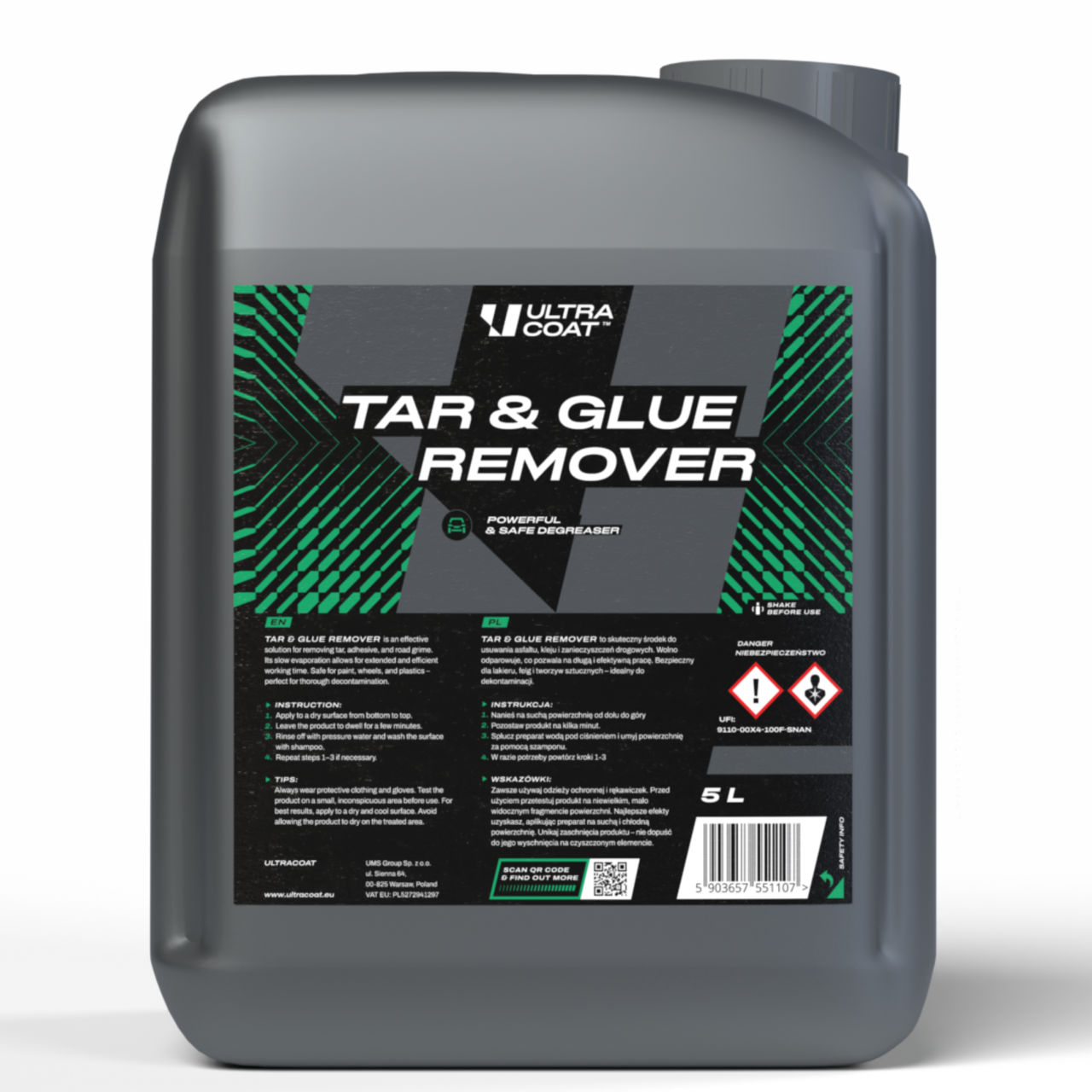
For the marks that survive everything else. Tar, adhesive and sticker residue, and it is safe on plastics.
Tar spots along the sills. The sticky grey outline where a dealer sticker used to be. Adhesive residue from a badge you removed, or from tape. None of it comes off with shampoo, and scrubbing at it with a mitt only puts scratches around it.
Tar & Glue Remover dissolves it. It is a solvent that evaporates slowly, which is deliberate, because the dissolving takes time and a fast-flashing product leaves you doing it four times.
The safety part is what makes it usable. Strong solvents usually mean staying well away from plastics and trim. This one stays safe on plastics, paint, wheels and ceramic coatings, so you can use it around bumpers and trim without the anxiety.
Menthol scent, which takes the edge off a job that normally smells of white spirit.
How to use it. Apply to a dry surface and work bottom to top, so runs land on product you have already applied rather than on dry paint. Leave it one to two minutes, and do not let it dry. Rinse with a pressure washer, then wash the area with Shampoo+. Repeat if the contamination is heavy.
- Removes tar, adhesive and sticker residue that nothing else touches
- Slow evaporation, so one application usually does it
- Safe on plastics, coatings and paint
- Essential before polishing or applying a coating
- Menthol scent
- 500 ml, 1 litre and 5 litres
Wear nitrile gloves and a protective mask, use it in a well-ventilated area and keep it away from eyes and skin. Always test on a small hidden area first. Technical support available.
Application Guide
Prepare. The surface must be dry. The product works best on dry paint.
Apply. Work bottom to top so runs land on treated surface.
Dwell. 1 to 2 minutes. Do not allow the product to dry on the panel.
Rinse. Pressure wash, then wash the area with Shampoo+.
Repeat. As required on heavy contamination.
Safety. Wear nitrile gloves and a protective mask. Use in a well-ventilated area and keep away from eyes and skin. Test on an inconspicuous area first.
Hazards. Danger. May be fatal if swallowed and enters airways. Causes skin irritation. Causes serious eye irritation.
Tar & Glue Remover handles the bonded organic and adhesive contamination that survives the wash and the iron remover. Tar, glue, sticker residue, tape adhesive and the fresh badge outlines you get on every used vehicle prep.
It belongs in your prep sequence. Anything left on the panel when the machine goes on gets dragged across the paint or smeared into the pad. Anything left when a coating goes on is a bonding failure waiting to become a warranty conversation.
Slow evaporation gives you a real working window instead of chasing the product down a sill, which means one pass instead of three.
Safe around plastics, which is the differentiator against most solvent decontaminants. Bumpers, trim, arch liners and coated surfaces are all fine, so you are not masking off half the car before you start.
- Safe on plastics, so no masking-up time
- Prevents the bonding failures that become coating warranty claims
- Slow evaporation gives one pass instead of three
- Essential on used-vehicle and forecourt prep where badge and sticker residue is standard
- Menthol scent, easier on an enclosed unit than most solvents
- 500 ml, 1 litre and 5 litres
Technical Application Notes
Preparation. The surface must be dry. The product works best on dry paint.
Application. Work bottom to top so runs land on treated surface.
Dwell. 1 to 2 minutes. Do not allow the product to dry on the panel.
Rinse. Pressure wash, then wash the area with Shampoo+.
Repeat. As required on heavy contamination.
In a correction workflow. After the iron remover, before clay and polish.
Safety. Wear nitrile gloves and a protective mask. Use in a well-ventilated area and keep away from eyes and skin. Test on an inconspicuous area first.
Hazards. Danger. May be fatal if swallowed and enters airways. Causes skin irritation. Causes serious eye irritation.
Support. Technical support available from Ultracoat UK.
Share